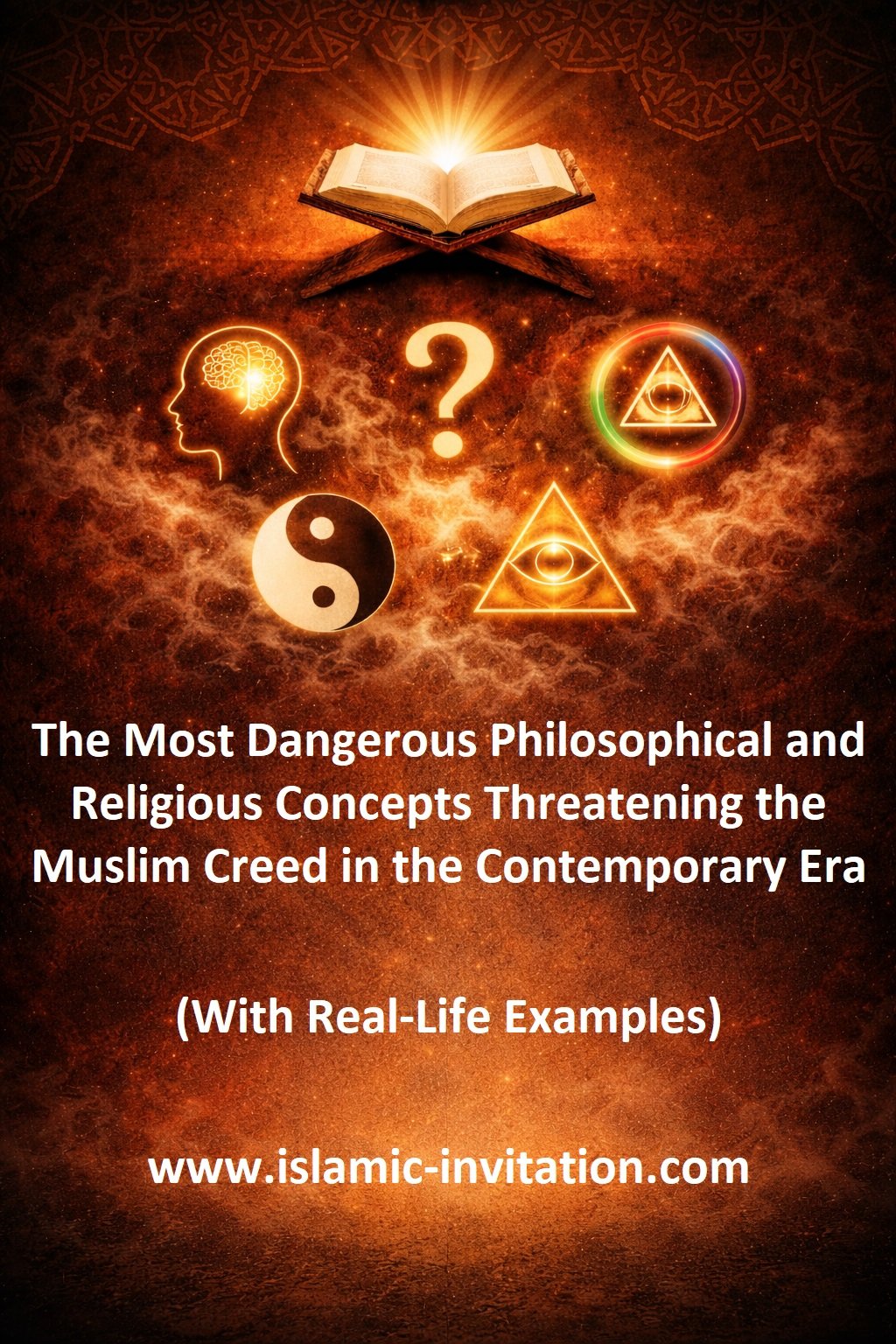
The Most Dangerous Philosophical and Religious Concepts Threatening the Muslim Creed in the Contemporary Era
(With Real-Life Examples)
Introduction
In the modern era, the threat to the Muslim creed is no longer limited to explicit atheism or clear polytheism. Rather, it has appeared in the form of contemporary intellectual, philosophical, and religious concepts presented under the guise of rationality, freedom, humanism, tolerance, and spirituality. These concepts are promoted through media, educational institutions, public culture, and social media platforms, making them even more dangerous, because they undermine faith from within rather than from outside, and weaken certainty without the Muslim even realizing it.
First: Direct Atheistic Concepts and Their Derivatives
1. Explicit Atheism
Definition: The denial of the existence of God, and the claim that the universe is the product of chance or natural laws alone.
Creedal Danger: • Denial of monotheism. • Elimination of purpose in creation and life. • Destruction of the concept of accountability and the Hereafter.
(Were they created by nothing, or were they themselves the creators?) (The Noble Qur'an - Surah At-Tur: 35)
Real-Life Examples: • A Muslim youth saying: “The universe came into existence through the Big Bang, and we do not need the hypothesis of God.” • Media and intellectual platforms attacking the Qur’an and Sunnah in the name of freedom of thought. • Mocking supplication and worship and considering them “psychological sedation.”
Result: Loss of monotheism → denial of accountability → immersion in desires without restraint.
2. Scientific Atheism
Definition: The claim that science alone is sufficient to explain existence, and that there is no need for belief in God or revelation.
Creedal Danger: • Denial of the unseen. • Deifying science and making it a substitute for revelation.
(Those who believe in the unseen) (The Noble Qur'an - Surah Al-Baqarah: 3)
Real-Life Examples: • Saying: “What cannot be proven by laboratory experiments is superstition.” • Denying angels, jinn, and the punishment of the grave due to lack of scientific detection. • Presenting materialistic evolutionary theory that denies divine creation.
Result: Sanctification of science → denial of the unseen → rejection of religious texts.
3. Spiritual Atheism
Definition: The denial of the existence of God while adopting spiritual and ethical concepts without religion or worship.
Creedal Danger: • Separating spirituality from worship. • Turning religion into a purely personal psychological experience.
(And I did not create the jinn and mankind except to worship Me) (The Noble Qur'an - Surah Adh-Dhariyat: 56)
Real-Life Examples: • A person saying: “I am spiritual but not religious.” • Practicing meditation without prayer, and claiming closeness to God without worship. • Replacing remembrance and supplication with what is called “inner peace.”
Result: Spirituality without monotheism → faith without servitude → religion without law.
4. Moral Atheism
Definition: The claim that sound morals can exist without belief in God or revelation.
Creedal Danger: • Separating morality from faith. • Denial of accountability and recompense.
The Prophet ﷺ said: “I was sent only to perfect noble character.” (Reported by Ahmad)
Real-Life Examples: • Saying: “We can be moral without religion.” • Rejecting Islamic legal punishments under the pretext of “humanity.” • Justifying immoral acts as long as they are consensual.
Result: Collapse of the balance between lawful and unlawful → moral chaos.
Second: Philosophical Concepts that Undermine Meaning and Purpose
5. Nihilism
Definition: The denial of meaning and purpose in life.
Creedal Danger: • Negation of divine wisdom in creation. • Spreading despair and existential emptiness.
(Did you think that We created you in vain?) (The Noble Qur'an - Surah Al-Mu’minun: 115)
Real-Life Examples: • The spread of phrases such as: “Life has no meaning.” • Youth saying: “We die and everything ends.” • Glorifying suicide in some films and novels.
Result: Despair → depression → loss of belief in divine decree and destiny.
6. Existentialism
Definition: A philosophical doctrine that focuses on individual human existence and makes man the one who determines the meaning of his life and values, independent of revelation.
Creedal Danger: • Negating the divine purpose of creation. • Imposing absolute responsibility on humans without divine reference. • Weakening belief in divine decree and destiny.
(And We did not create the heaven and the earth and what is between them in play) (The Noble Qur'an - Surah Al-Anbiya’: 16)
Real-Life Examples: • Repeated questions: “What is the meaning of life? Why do we live?” without returning to revelation. • Considering faith a “personal choice” rather than an absolute truth. • Preferring individual experience over religious text.
Result: Loss of purpose → existential anxiety → weakening of certainty in God and His wisdom.
7. Materialism
Definition: Restricting existence to matter and denying the soul and the unseen.
Creedal Danger: • Denial of the unseen world. • Attachment to worldly life and forgetting the Hereafter.
Real-Life Examples: • Measuring a person’s value by wealth or position. • Emphasizing the slogan: “Live your life” without regard for the Hereafter. • Considering religion an obstacle to progress.
Result: Attachment to worldly life → hardness of the heart → forgetting the Hereafter.
8. Postmodernism
Definition: Denial of absolute truth and making everything relative, including religion.
(And say: Truth has come, and falsehood has vanished) (The Noble Qur'an - Surah Al-Isra’: 81)
Real-Life Examples: • Saying: “There is no absolute truth.” • Considering Islamic law (Sharia) merely a “historical viewpoint.” • Denying the existence of fixed right and wrong.
Result: Destruction of certainty → doubt in revelation → religious relativism.
Third: Intellectual Concepts that Deify the Human Being and the Self
9. Individualism
Definition: Prioritizing individual freedom and desires over the commands of God and society.
Creedal Danger: • Deifying personal desire. • Marginalizing Islamic law (Sharia).
(Have you seen the one who takes his desire as his god?) (The Noble Qur'an -Surah Al-Jathiyah: 23)
Real-Life Examples: • The slogan: “My body is mine; I do with it as I please.” • Rejecting religious commands under the claim of personal freedom. • Preferring desire over God’s ruling.
Result: Following desire → weakening of servitude → fragmentation of society.
10. Self-Worship
Definition: Making the human being the center of the universe and the source of values and legislation.
Creedal Danger: • Negation of servitude to God. • Spreading egoism and arrogance.
Real-Life Examples: • Slogans such as: “Love yourself above everything.” • Considering personal happiness the criterion of truth. • Rejecting sacrifice or religious commitment.
Result: The ego instead of God → inflated self → neglect of servitude.
11. Humanism
Definition: A philosophy that makes human beings, their intellect, and their needs the supreme reference for values and legislation instead of divine revelation.
Creedal Danger: • Deifying the human intellect. • Eliminating the need for revelation and prophethood. • Rejecting Islamic rulings that conflict with contemporary human desires.
(It is nothing but a reminder for the worlds) (The Noble Qur'an - Surah Yusuf: 104) (It is not for a believing man or woman, when Allah and His Messenger have decided a matter, to have any choice in their affair) (The Noble Qur'an - Surah Al-Ahzab: 36)
Real-Life Examples: • Prioritizing “human rights” in their Western formulation over Islamic law (Sharia).
• Rejecting Islamic punishments under the claim that they violate human dignity. • Redefining justice and injustice away from revelation.
Definition: The belief that God and the universe are one.
Creedal Danger: • Denial of monotheism. • Eliminating the distinction between Creator and creation.
(There is nothing like unto Him) (The Noble Qur'an - Surah Ash-Shura: 11)
Real-Life Examples: • Saying: “God is in everything” in the sense of indwelling. • Considering nature sacred. • Justifying the worship of the universe and energy.
Result: Doctrinal polytheism → loss of monotheism → invalidation of worship.
13. Religious Universalism / Unity of Religions
Definition: The claim that all religions are true and lead to salvation.
Creedal Danger: • Explicit denial of the Qur’an. • Nullifying the meaning of da‘wah.
(Indeed, the religion with Allah is Islam) (The Noble Qur'an - Surah Aal ‘Imran: 19)
Real-Life Examples: • Saying: “All religions are paths to God.” • Interfaith joint prayers. • Considering disbelief merely a cultural difference.
Result: Eliminating the meaning of Islam → collapse of da‘wah → dilution of creed.
14. Abrahamic Movements
Definition: Calling for the merging of Islam, Christianity, and Judaism into one religion.
Creedal Danger: • Mixing truth with falsehood. • Eliminating the uniqueness of Islam.
Real-Life Examples: • Conferences promoting the unity of religions. • Joint prayers between Muslims, Christians, and Jews. • Erasing doctrinal differences under the pretext of peace.
Result: Dilution of monotheism → loss of doctrinal identity.
15. New Age Movement
Definition: A mixture of Eastern spiritualities and cosmic energy beliefs.
Creedal Danger: • Hidden polytheism. • Replacing revelation with superstition.
Real-Life Examples: • Belief in cosmic energy. • Healing with stones. • Invoking “positive vibrations.”
Result: Hidden polytheism → replacing reliance on God with superstition.
Fifth: Masked Contemporary Social and Intellectual Concepts
16. Moral Relativism
Definition: Denial of absolute and fixed moral values.
Creedal Danger: • Suspension of Islamic law (Sharia).
• Justification of corruption.
(Judgment belongs to none but Allah) (The Noble Qur'an - Surah Yusuf: 40)
Real-Life Examples: • “What you see as forbidden may be permissible for others.” • Justifying adultery and homosexuality. • Denying the permanence of Islamic rulings.
Result: Elimination of Islamic law (Sharia) → spread of corruption.
17. Liberalism
Definition: An intellectual doctrine that prioritizes individual freedom, rights, and desires over any fixed religious or moral reference.
Creedal Danger: • Prioritizing freedom over servitude to God. • Justifying prohibitions under the name of personal rights. • Reinterpreting religious texts according to desires.
(If the truth were to follow their desires, the heavens and the earth would be corrupted) (The Noble Qur'an - Surah Al-Mu’minun: 71)
Real-Life Examples: • Debates over freedom to change religion (apostasy). • Justifying homosexuality and forbidden relationships under personal rights. • Attacking Islamic rulings under the claim of “freedom.”
Result: Sanctifying freedom → abolishing Islamic constraints → doctrinal and moral chaos.
18. Secularism
Definition: An intellectual and political concept based on separating religion from the state, legislation, and public life, and confining religion to the personal or ritual sphere.
Creedal Danger: • Excluding God’s law from governance and legislation. • Making human authority the supreme reference for laws instead of divine authority. • Weakening the concept of Islam’s comprehensiveness and its validity for all times and places.
(Is it the judgment of ignorance they seek? And who is better than Allah in judgment for a people who are certain?) (The Noble Qur'an - Surah Al-Ma’idah: 50)
Real-Life Examples: • Debates about excluding Islamic law (Sharia) from constitutions and laws. • Calls to neutralize religion in education and media. • Restricting the role of scholars and religious institutions in public affairs.
Result: Excluding revelation → judging by human reason → stripping Islam of its comprehensiveness.
19. Radical Feminism
Definition: Rejecting natural disposition and demanding absolute equality that contradicts Islamic law (Sharia).
Result: Rejection of legislation → denial of natural disposition → clash with religion.
20. Cultural Globalization
Definition: Imposing a global cultural model that dissolves religious identities.
Creedal Danger: • Erasing Islamic identity. • Value-based subservience to the West.
Real-Life Examples: • Imposing Western values globally. • Mocking hijab and Islamic punishments. • Presenting the Western model as the moral reference.
Result: Dissolution of identity → weakening of Islamic belonging.
Comprehensive and Cautionary Conclusion
The most dangerous threat to the Muslim creed today is: • Not explicit disbelief, but disguised concepts. • Not direct attacks, but soft dismantling.
These concepts: • Do not come with the phrase “Disbelieve in God.” • Rather, they come with slogans such as: Freedom – Reason – Humanism – Spirituality – Tolerance.
The real danger: That a Muslim adopts them without realizing that they undermine his creed.





.jpg)